
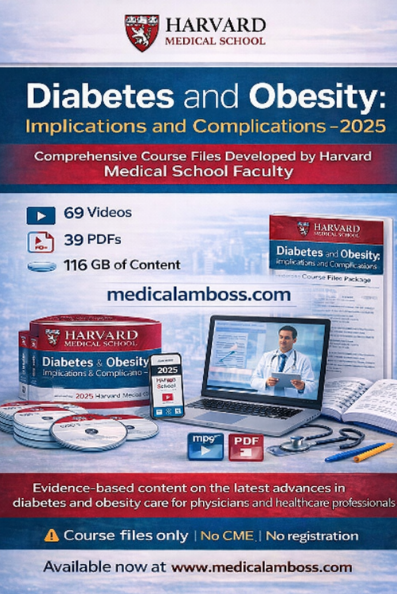
Harvard Diabetes and Obesity Implications and Complications 2025
$100.00
This Product is shared via google drive download link, So please share your correct Gmail id while placing the order .Please note that there are no CME points or certificate associated with this course Samples for Courses Can be found here : Free Samples Here!
Include: 69 videos + 39 pdfs, size: 116 GB
Harvard Diabetes and Obesity Implications and Complications 2025
Include: 69 videos + 39 pdfs, size: 116 GB
Target Audience: primary care physicians, endocrinologists, internists, family physicians, hospital medicine physicians
Information:
Updates, Guidance, and Best Practices for Patients with Diabetes
For those of you who provide care to individuals with—or at risk for—diabetes, managing the complex interplay of comorbidities and complications can be challenging. Obesity, a major contributor to the development and progression of diabetes and many of its comorbidities, plays a critical role in patient outcomes and requires targeted strategies for effective management.
With these challenges in mind, Harvard Medical School faculty developed this CME program, Diabetes and Obesity: Complications and Implications, to provide the latest updates, practice recommendations, and evidence-based strategies for optimizing patient care. This program delivers comprehensive education with practical insights to enhance your clinical practice immediately. We will address the following:
- Screening for diabetes and diagnostic criteria for obesity and diabetes
- Clinical approaches to weight management, including lifestyle interventions, pharmacotherapy, and surgery
- Pharmacological management of diabetes, including the latest in insulin and non-insulin therapies and their impact on weight management
- Advances in insulin delivery and glucose monitoring technologies
- Obesity as a comorbidity and its impact on diabetes progression, cardiovascular health, morbidity, and mortality
- Treatment of diabetes-related complications, including dyslipidemia, hypertension, peripheral vascular disease, cardiovascular disease, kidney disease, liver disease, and the diabetic foot
- Care considerations for older adults with diabetes and/or obesity
- Incorporating recent therapeutic advances into your practice
- Challenging patient cases and real-world applications
Education to Optimize Patient Care and Outcomes
Education is focused on optimizing patient care and outcomes and improving skills in the following areas:
- Insulin initiation and intensification: which insulins to choose and why
- Understanding the new insulins, glucose monitors, and pumps
- Treating people with type 2 diabetes who are not achieving therapeutic goals
- Office-based assessment and treatment of comorbidities and complications
- Individualizing multifaceted approaches to lifestyle modification and weight management
- Personalizing nutrition plans and exercise prescriptions
- Cardiovascular risk reduction and care
- Pharmacotherapy for diabetes and obesity: GLP-1 receptor agonists and the spectrum of other options now available
- Optimal management of neuropathies and foot disease
- Managing diabetes in high-risk populations, including pregnant patients and the elderly
- Understanding the evolving concepts and treatments that will soon impact your day-to-day practice
- Communicating with, motivating, and sharing resources with patients
- Recognizing social, racial, sexual, and cultural biases in diabetes care and reviewing strategies for achieving equity and addressing disparities
Learning Objectives
At the end of this course, you will be able to:
- Describe the pathophysiology of type 1 and type 2 diabetes, how it is related to the development/progression of key diabetes comorbidities, and how knowledge of pathophysiology drives prevention and treatment.
- Identify ways to improve skills and office-based care systems to optimize lifestyle interventions in the treatment of diabetes, obesity, and related conditions.
- Describe the implications and impact of the latest evidence-based expert treatment guidelines for lifestyle, pharmacologic, and technologic treatments of diabetes and its comorbidities.
- Recognize how the evolving clinical implications of cardiovascular and renal outcomes trials of antidiabetes medications can be effectively applied to the prevention, diagnosis, and treatment of these comorbidities of diabetes.
- Apply the latest preventive, diagnostic, and treatment approaches to the care of the various disease and treatment-related comorbidities of diabetes impacting eyes, nerves, peripheral vascular and foot, liver, bone, and issues with hypoglycemia, and in special populations of people with diabetes such as the elderly, pregnant women, and hospitalized individuals.
- Identify and overcome clinical practice barriers emanating from patients, providers, and practice systems issues.
- Communicate with people with diabetes, families, and health team members in a responsive manner that supports a team approach to the promotion and maintenance of health, as well as prevention and treatment of disease in individuals with diabetes.
Who Should Attend
- Physicians, NPs, PAs, RNs, Pharmacists in the fields of:
- Endocrinology
- Internal Medicine
- Family Medicine
- Hospital Medicine
- Geriatrics
- Cardiology
- Nephrology
- Diabetes Educators
- Dietitians
- Other healthcare professionals who care for patients with diabetes or treat their comorbidities and complications.
Topics:
Wednesday, Oct. 22, 2025
9:00am – 9:10am Introduction and Welcome: A Collective Call to Action
COMPREHENSIVE APPROACHES TO OBESITY: BLUNTING ITS IMPACT
9:10am – 9:43am Complementary & Alternative Medicines for Frank J. Domino, MD
Weight Loss, Diabetes and Life
9:43am – 10:13am Tailoring Nutrition for Success: Personalized Jody Dushay, MD, MMSc
Strategies for Weight Management*
10:13am – 10:28am Burning Clinical Question: I Want to Start a GLP-1 RA, Jody Dushay, MD, MMSc
but I’m Worried About Muscle Loss: What Is Known
and What Can I Do to Prevent It?
10:28am – 10:50am Q&A Session
10:50am – 11:00am BREAK AND STRETCH
11:00am – 11:28am Physiology of Exercise Maria Vamvini, MD
11:28am – 12:00pm Personalizing the Exercise Prescription: An Office- Edward M. Phillips, MD
Based Approach
12:00pm – 12:15pm Q&A Session
12:15pm – 1:00pm LUNCH BREAK
MEDICAL AND SURGICAL MANAGEMENT OF OBESITY
1:00pm – 1:42pm Pharmacologic Management of Obesity: Rapidly Osama Hamdy, MD, PhD, FACE
Expanding Options*
1:42pm – 2:16pm Modern Surgical Treatment of Obesity: Techniques Souheil W. Adra, MD, FACS, ABOM
and Patient Outcomes *
2:16pm – 2:30pm Q&A Session
2:30pm – 2:45pm BREAK AND REJUVENATION EXERCISES
UPDATES ON THE MEDICAL MANAGEMENT OF DIABETES
2:45pm – 3:40pm Beyond Metformin: Navigating and Applying the Martin J. Abrahamson, MD, FACP,
New Guidelines and Reducing Cardiovascular Risk* FRCP (London)
3:40pm – 3:45pm BREAK AND STRETCH
3:45pm – 4:40pm Newer Insulins and How to Use Them: Richard S. Beaser, MD
A Comprehensive Primer
4:40pm – 4:55pm Burning Clinical Question: How Can I Learn to Count Gillian Arathuzik, RD, LDN, CDCES
Carbohydrates in 10 Minutes?
4:55pm – 5:10pm Burning Clinical Question: My Patient with Type 2 Martin J. Abrahamson, MD, FACP,
Diabetes Just Had a Stent – Do I Need to Change Their FRCP (London)
Medications?
Thursday, Oct. 23, 2025
9:00am – 9:20am Recap of Day 1 Richard S. Beaser, MD
MACROVASCULAR DISEASE AND DIABETES
9:20am – 10:05am Managing Hypertension in People with Diabetes: Melanie P. Hoenig, MD
Evolving Clinical Challenges
10:05am – 10:15am BREAK AND STRETCH
10:15am – 10:58am Managing Dyslipidemia in Diabetes: Om P. Ganda, MD, MBBS, MACE
Individualizing Treatment Options
10:58am – 11:10am Q&A Session
11:10am – 12:10pm KEYNOTE: Microbiome (The Second Human Genome): Sanjiv Chopra, MD, MACP, FRCP
What Shapes It and How It Shapes Us (London)
12:10pm – 1:00pm LUNCH BREAK
CARDIOVASCULAR DISEASE AND DIABETES
1:00pm – 1:32pm Management of Acute Coronary Syndromes and Donald E. Cutlip, MD
Chronic Cardiovascular Disease in Patients with
Diabetes
1:32pm – 2:14pm Diabetes and Heart Failure: Update on Management A. Reshad Garan, MD, MS, FACC
2:14pm – 2:30pm BREAK AND REJUVENATION EXERCISES
2:30pm – 2:55pm Common Cardiovascular Tests and Their Optimal Michael C. Gavin, MD, MPH, FACC
Interpretation
2:55pm – 3:20pm Panel Discussion: Cardiovascular Care in People with A. Reshad Garan, MD, MS, FACC
Diabetes Michael C. Gavin, MD, MPH, FACC
Donald E. Cutlip, MD
3:20pm – 3:25pm BREAK AND STRETCH
MISCELLANEOUS
3:25pm – 4:15pm Metabolic-Associated Steatotic Liver Disease (MASLD) Sanjiv Chopra, MD, MACP, FRCP
(London)
4:15pm – 5:05pm Screening, Prevention, and Early Treatment of Jason L. Gaglia, MD, MMS
Type 1 Diabetes
Friday, Oct. 24, 2025
9:00am – 9:20am Recap of Day 2 Martin J. Abrahamson, MD, FACP,
FRCP (London)
Richard S. Beaser, MD
EMERGING TECHNOLOGIES AND CHALLENGES IN DIABETES
9:20am – 10:15am Tech-Enabled Diabetes Care: Tools and Innovations Anne Peters, MD
for Better Outcomes*
10:15am – 10:25am BREAK AND STRETCH
10:25am – 10:40am Burning Clinical Question: How Do I Start Insulin Richard S. Beaser, MD
in a Person Who Is Not Well Controlled on Non-
Insulin Medications?
10:40am – 11:30am Overcoming Hypoglycemia: Prevention and Mary-Elizabeth Patti, MD
Treatment in Modern Diabetes Care
11:30am – 11:35am BREAK AND STRETCH
11:35am – 12:25pm KEYNOTE The Expanding Universe of GLP-1 Daniel J. Drucker, FRS, FRCPC, OC
Medicines
12:25pm – 1:10pm LUNCH BREAK
1:10pm – 1:50pm Diabetes in Older Adults: Unique Perspectives in This Medha N. Munshi, MD
Important Population*
1:50pm – 2:35pm Inpatient Management of Diabetes: Strategies and Zachary H. Taxin, MD
Transition to the Outpatient Setting*
2:35pm – 2:50pm Q&A Session
2:50pm – 3:05pm BREAK AND REJUVENATION EXERCISES
3:05pm – 3:50pm Future Therapies for Diabetes* Alan C. Moses, MD, FACP
3:50pm – 4:30pm Strategies to Promote Equity in Diabetes Care* Leonor Fernandez, MD
4:30pm – 4:40pm Q&A Session
4:40pm – 4:45pm BREAK AND STRETCH
4:45pm – 5:00pm Burning Clinical Question: How Do I Transition to Richard S. Beaser, MD
a Full Basal/Bolus Insulin Program?
5:00pm – 5:15pm Burning Clinical Question: How Do I Interpret My Martin J. Abrahamson, MD, FACP,
Patient’s CGM Data FRCP (London)
Saturday, Oct. 25, 2025
9:00am – 9:20am Recap of Day 3 Martin J. Abrahamson, MD, FACP,
FRCP (London)
Richard S. Beaser, MD
MULTIDISCIPLINARY CASE WORKSHOP: BRINGING KNOWLEDGE TOGETHER
9:20am – 10:25am Multidisciplinary Case Workshop and Panel Martin J. Abrahamson, MD, FACP,
Discussion FRCP (London)
Richard S. Beaser, MD
Melanie P. Hoenig, MD
Om P. Ganda, MD, MBBS, MACE
Donald E. Cutlip, MD
10:25am – 10:40am BREAK AND STRETCH
SPECIAL POPULATIONS AND MICROVASCULAR COMPLICATIONS
10:40am – 10:55am Burning Clinical Question: My Patient with Type 2 Florence M. Brown, MD
Diabetes Wants to Become Pregnant – How
Should I Counsel Her?*
10:55am – 11:10am Burning Clinical Question: My Patient with Type 1 Florence M. Brown, MD
Diabetes Just Found Out She Is Pregnant – What’s
the Optimal Management?*
11:10am – 12:00pm KEYNOTE: Artificial Intelligence in Medicine Adam M. Rodman, MD, MPH
12:00pm – 12:45pm LUNCH BREAK
12:45pm – 1:23pm Retinopathy in Diabetes: Innovations in Screening Deborah K. Schlossman, MD
and Treatment
1:23pm – 2:09pm Treatment of Renal Disease: Guidance to Blunt Melanie P. Hoenig, MD
the Impact and Slow the Progression
2:09pm – 2:20pm Q&A Session
2:20pm- 2:35pm BREAK AND REJUVENATION EXERCISES
2:35pm – 3:20pm Evaluating and Treating Neuropathies of Diabetes: Patricia E. Greenstein, MBBCh
2025 Updates
3:20pm – 3:25pm BREAK AND STRETCH
THE DIABETIC FOOT
3:25pm – 4:02pm Preserving the Health of the Diabetic Foot: Practical John M. Giurini, DPM
Approaches *
4:02pm – 4:27pm Peripheral Vascular Disease in Diabetes: Innovations David R. Campbell, MD, FRCS,
and Best Practices FACS
4:27pm – 4:45pm Q&A Session
4:45pm – 4:50pm Indispensable Tips for Incorporating Updates into
Clinical Practice, and Closing Remarks
Related products

Endocrine and Nutrition COURSES
Harvard Testosterone Therapy and Sexual Dysfunction February 2023
Endocrine and Nutrition COURSES


Endocrine and Nutrition COURSES
Diabetes and Obesity Patient Centered Management 2023 ( VIDEOS )

Endocrine and Nutrition COURSES
The Brigham Board Review and Comprehensive Update in Endocrinology 2023 ( VIDEOS)
Endocrine and Nutrition COURSES
Harvard Diabetes and Obesity Patient centered Management “ Caring for the Whole Patient ” 2023
Endocrine and Nutrition COURSES