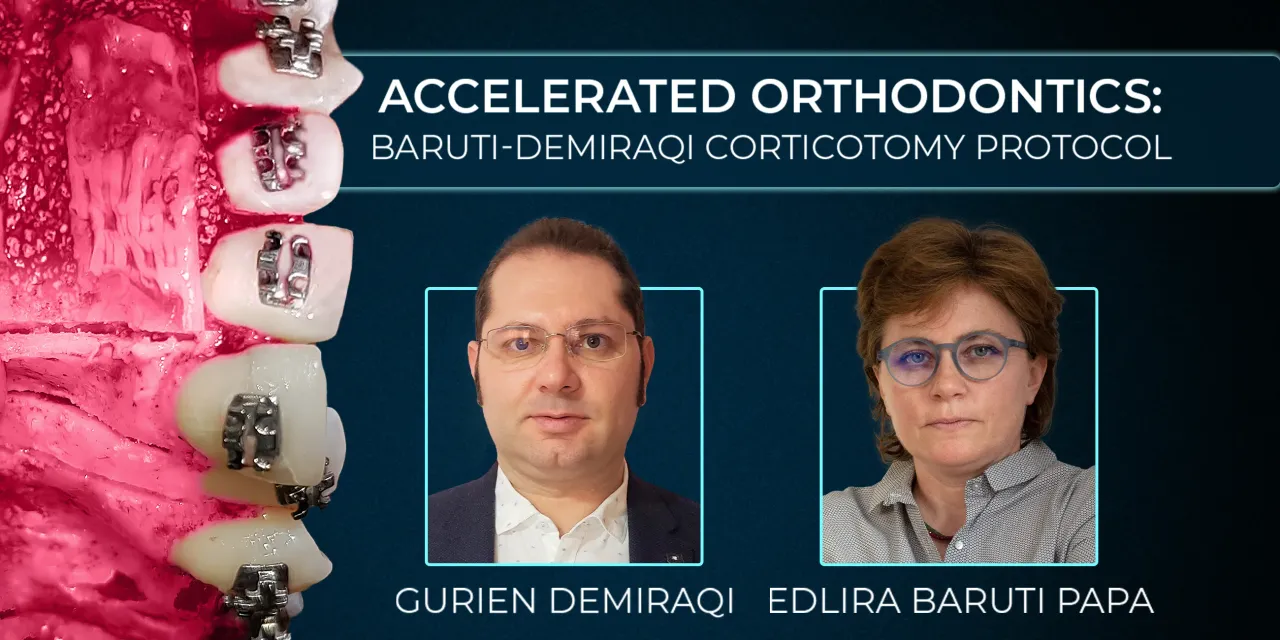
OHI-S Accelerated orthodontics Baruti-Demiraqi corticotomy protocol
+ Include: 5 videos + 5 audios + 5 file sub vtt, size: 3.62 GB
+ Target Audience: orthodontists, implantologists, oral and maxillofacial surgeons, general dentists
+ Information:
5 lessons (6h 15min)
The author’s improved protocol of corticotomy in orthodontics is presented in a new course by Gurien Demiraqi, a surgeon and Edlira Baruti Papa, an orthodontist.
- – Oral surgeons will learn the step-by-step protocol of corticotomy.
- – Orthodontists will learn how to treat all common malocclusions in patients after conducting corticotomy.
- Together with the lecturers and their protocol for successful and stable long-term treatment results of 10 years, you will learn how to:
- – Reduce the time of orthodontic treatment
- – Simultaneously perform corticotomy and recessions closure
- – Have a minimum of postoperative complications.
The OHI‑S Accelerated Orthodontics: Baruti‑Demiraqi Corticotomy Protocol course is best for orthodontists, oral surgeons, and advanced general dentists who want structured, CE‑accredited training in surgically‑assisted orthodontics. It emphasizes corticotomy techniques to shorten treatment time, improve tooth movement efficiency, and integrate interdisciplinary care.
Who Should Enroll
- Orthodontists seeking to reduce treatment duration and manage complex malocclusions with accelerated protocols.
- Oral & maxillofacial surgeons performing corticotomy procedures in collaboration with orthodontists.
- Advanced general dentists expanding into interdisciplinary orthodontic treatment with surgical adjuncts.
- Residents & fellows in orthodontics or oral surgery learning structured accelerated orthodontic workflows.
- Prosthodontists & restorative dentists involved in interdisciplinary cases where orthodontic acceleration supports rehabilitation.
What You’ll Learn
- Baruti‑Demiraqi corticotomy protocol: step‑by‑step surgical technique for accelerated orthodontics.
- Biological basis: how corticotomy enhances bone remodeling and speeds tooth movement.
- Case selection: identifying patients who benefit most from accelerated orthodontics.
- Interdisciplinary integration: combining corticotomy with orthodontic, prosthodontic, and restorative treatments.
- Complication management: minimizing risks and ensuring predictable outcomes.
- Case‑based lessons
+ Topics:
Lesson 1.Сorticotomy from the orthodontic point of view
- – Malocclusion as a public health problem: the growing prevalence of crooked teeth
- – Malocclusion relations to the size of our jaws, a key precipitating factor
- – The historical journey of rapid orthodontic movement: bone modeling, osteoclasts, and osteoblasts
- – Classification of gingival and periodontal biotype
- – Biological and histological bases of tooth movement and Regional Acceleratory Phenomenon (RAP)
- – Periodontal considerations in orthodontic and orthopaedic tooth movement
- – Root resorption associated with palatal expansion
- – Patient selection criteria
- – Orthodontic adjustments and clinical applications.
Recommended for: Orthodontists, Implantologists, Oral and Maxillofacial Surgeons, General dentists.
Lesson 2.Сorticotomy from the surgical point of view
- – From osteotomy to corticotomy to tissue engineering
- – Indication, limitations, and complications for various techniques of corticotomy
- – Selective Alveolar Decortication (SAD): the contemporary method
- – Accelerated osteogenic orthodontics
- – Regional accelerated phenomenon (RAP)
- – Periodontally accelerated osteogenic orthodontics (PAOO)
- – The monocortical technique for dental dislocation and periodontal ligament distraction (MTDLD)
- – The piezocision technique
- – Minimally invasive procedure conducted with endoscopy-assisted tunnel
- – Micro-osteoperforation by Alikhani M.
- – The Baruti-Demiraqi approach
- – Corticotomy – assisted orthodontic treatment (CAOT)
- – Surgically facilitated orthodontic therapy (SFOT)
- – Corticotomy facilitated orthodontics (CFO)
- – The conventional corticomy technique: one stage and two stage technique
- – Corticision. piezocision, discision, and laser assisted flapless corticotomy
- – Rates of tooth movement and force application.
Recommended for: Orthodontists, Implantologists, Oral and Maxillofacial Surgeons, General dentists.
Lesson 3.The Baruti-Demiraqi approach. An enhanced PAOO with hard and soft tissue grafting
- – Patient selection criteria and preoperative considerations
- – Preoperative assessments: extra and intra oral examination
- – Radiological assessment: CBCT interpretation
- – The necessity of blood and biochemical analysis
- – Anesthesia: local and IV
- – The step-by-step surgical procedure of the Baruti-Demiraqi approach
- – Hard and soft tissue grafting
- – Complications of hard and soft tissue graft
- – Allograft: blood concentrated growth factor (BCGF) + sticky bone
- – Autologous graft: autogenous tooth graft, blood concentrated growth factor (BCGF) + sticky tooth
- – How to harvest autologous bone intraorally?
- – How to extend soft tissue during corticotomy?
- – Post operative surgical follow up
- – Orthodontic treatment step by step
- – Short and long term surgical and orthodontic assessments.
Recommended for: Orthodontists, Implantologists, Oral and Maxillofacial Surgeons, General dentists.
Lesson 4.The Baruti-Demiraqi approach: сases presentation for each indication. Part 1
- – Facilitate eruption of impacted teeth:
- – Partial PAOO and BCGF.
- – Facilitate slow arch orthodontic expansion (Cl 2 / Cl 3):
- – PAOO with membrane coverage
- – PAOO with BCGF and “sticky tooth”.
- – Uprighting, mesialization, distalization single tooth:
- – Partial PAOO with BCGF and “sticky tooth”.
- – Polydiastema and space closure:
- – PAOO with BCGF membrane coverage.
- – Accelerate retraction of canine:
- – PAOO with BCGF and “sticky bobe”.
- – The main goal of the Baruti-Demiraqi approach.
Recommended for: Orthodontists, Implantologists, Oral and Maxillofacial Surgeons, General dentists.
Lesson 5.The Baruti-Demiraqi approach: сases presentation for each indication. Part 2
- – Resolve crowding and shorten treatment time:
- – PAOO with BCGF membrane coverage
- – PAOO with BCGF and “sticky tooth”.
- – Open bite correction and molar intrusion:
- – PAOO with BCGF and “sticky tooth”.
- – Manipulation of anchorage:
- – PAOO with BCGF and “sticky tooth”.
- – Facilitating the movement of the teeth with Internal Root Resorption:
- – Corticotomy BCGF with “sticky tooth”.
- – Facilitating the movement of tooth with dilacerated roots:
- – PAOO with BCGF and “sticky bone”.
- – Deep bite and canting correction:
- – Bilateral Sagittal Split Osteotomy (BSSO)
- – Selective corticotomy
- – PAOO with BCGF and “sticky bone”
- – PAOO with BCGF membrane coverage.