
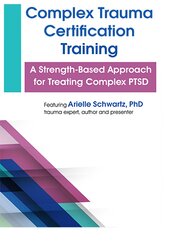
Complex Trauma Certification Training: A Strength-Based Approach for Treating Complex PTSD

$40.00
This Product is shared via google drive download link, So please share your correct Gmail id while placing the order .Please note that there are no CME points or certificate associated with this course Samples for Courses Can be found here : Free Samples Here!
Duration: 24 Hours 21 Minutes
Format: Audio and Video
Copyright: Feb 7, 2018
Complex Trauma Certification Training: A Strength-Based Approach for Treating Complex PTSD
Duration: 24 Hours 21 Minutes
Format: Audio and Video
Copyright: Feb 7, 2018
Many clinicians are trained in the treatment of single traumatic events, but are not fully equipment to treat Complex PTSD. The traditional approaches to the treatment of PTSD can fall short when working with clients with Complex PTSD. Watch this workshop to learn how you can adapt your therapeutic approach to help clients diagnosed with Complex PTSD achieve more successful outcomes.
The most common question asked when treating Complex PTSD is, “where do I start?”. In this training, you will develop confidence in your ability to successfully organize and prioritize your client’s treatment goals. You will learn how to compassionately and effectively work with clients who have experienced multiple traumatic events and prolonged trauma exposure.
Successful treatment requires a compassionate therapeutic relationship and effective, research-based interventions. After this training you will learn how to:
- Help clients move out of crisis by building stabilizing resources
- Prepare clients to work through traumatic memories without becoming overwhelmed
- Develop an integrative trauma treatment plan that includes CBT, DBT, EMDR Therapy, Somatic Psychology, Parts Work Therapy, and Complementary and Alternative Medicine (CAM)
Watch Dr. Arielle Schwartz, trauma expert, trainer and author of The Complex PTSD Workbook, in this engaging and interactive seminar to learn valuable strategies that will allow you to successfully address the dysregulated affect and arousal states that accompany Complex PTSD. You will leave this seminar with practical tools that facilitate a strength-based approach to trauma recovery and increased resilience in clients.
Bonus!
Become A Certified Clinical Trauma Professional Level II (CCTP-II)!
Best of all, upon completion of this live training, you’ll be eligible to become a Certified Clinical Trauma Professional Level II (CCTP-II)* through Evergreen Certifications. Certification lets colleagues, employers, and clients know that you’ve invested the extra time and effort necessary to understand the complexities of trauma counselling. Professional standards apply.
Target Audience
- Counselors
- Social Workers
- Psychologists
- Physicians
- Case Managers
- Psychotherapists
- Addiction Counselors
- Marriage and Family Therapists
- Nurses
- Other Mental Health Professionals
Objectives
- Distinguish key contributing factors to the development of Complex PTSD as it relates to client case conceptualization.
- Analyze the impact of Complex PTSD on the cognitive, emotional, and physical health of the client.
- Determine how to assess clients for Complex PTSD symptoms within other diagnoses, including personality disorders, mood disorders, anxiety disorders, and dissociative disorders.
- Incorporate into clinical treatment practical mind-body therapy tools to help clients feel resourced and prepared for trauma processing.
- Articulate the six stages of trauma responses within the neurobiology of Complex PTSD as it relates to clinical treatment.
- Utilize assessment tools to properly assess for Complex PTSD to better inform treatment planning.
- Analyze implicit memory foundations of preverbal and nonverbal memories.
- Breakdown how mutual regulation within the therapeutic relationship teaches clients self-regulation strategies that help them develop new interpersonal strengths that help with the treatment process.
- Analyze parts work from Structural Dissociation, Internal Family Systems, and Gestalt perspectives.
- Evaluate the basic principles of a unified approach to somatic psychology.
- Implement mindfulness-based techniques into trauma treatment.
- Integrate interventions for the treatment of Complex PTSD drawn from CBT, DBT, EMDR Therapy, Parts Work Therapy, Somatic Psychology, and mind-body therapies.
- Determine how the neuroscience of interpersonal neurobiology provides insight into the psychobiological changes possible within trauma treatment.
- Analyze how working within the “Window of Tolerance” can help reduce the likelihood of re-traumatization.
- Assess how “top-down” and “bottom-up” interventions can speed up or slow down the pacing of trauma treatment.
- Differentiate past experience from present moment experience as it relates to the treatment of trauma.
- Employ resilience as a strength-based approach that fosters growth and integration of a positive sense of self-identity in clients.
- Evaluate the role of neuroplasticity in treating trauma.
- Determine resilience and protective factors to aid against the development of PTSD.
- Demonstrate effective strategies for working with clients’ preverbal memories.
- Utilize relational interventions for shame.
- Utilize EFT, Havening Technique, and other “neuromodulation” strategies for trauma recovery.
- Apply techniques of focusing and resourcing to prepare clients for trauma reprocessing.
- Analyze somatic cues to determine level of internal trauma processing.
- Employ coregulation to reduce level of client distress.
- Adapt standard trauma therapy to the increased demands of complex PTSD.
Outline
Post-Traumatic Stress Disorder vs. Complex PTSD: Understand the Difference
- Acute traumatic stress, PTSD, Complex PTSD
- Diagnostic clarification, differential diagnosis and co-morbidities
- Key contributing factors of Complex PTSD
- The common symptoms of Complex PTSD
The Neurobiology of PTSD: Beyond Fight and Flight
- Polyvagal Theory
- Stages of trauma response
- Trauma specific psychopharmacology
- Heart Rate Variability and the Social Nervous System
- Interpersonal Neurobiology
- Psychobiological regulation
- Rupture and repair
- Implications of childhood neglect or abuse
- Neuroplasticity and Complex PTSD
Psychological and Physiological Repercussions of Complex PTSD: A Deeper Understanding for Accurate Assessment
- Intrusive symptoms and anxiety
- Emotional dysregulation: Outbursts of anger and debilitating shame
- Avoidance symptoms and phobic reactions to traumatic material
- Interpersonal problems and difficulty being close to others
- Dissociation and dysregulation
- Cognitive distortions and compromised meaning making
- Physical health problems, ACE factors and painful somatization
- Preverbal and nonverbal memories
- Disturbing somatic sensations
- Depressive symptoms
- Learned helplessness and shame
Therapeutic Interventions for Complex PTSD: Summary of Effective Therapies
- Psychodynamic and Relational Therapy
- Psychobiological perspectives: Polyvagal Theory
- Cognitive Behavioral Therapy (CBT)
- Dialectical Behavioral Therapy (DBT)
- EMDR Therapy
- Somatic Psychology
- Parts Work Therapy: Work with Ego States
- Complementary and Alternative Medicine (CAM):
mindfulness, yoga, and integrative healthcare
Integrative Treatment for Complex PTSD: Putting it All Together for an Effective Treatment Plan
- A Biopsychosocial Approach: Partner with clients to build a health care team
- Goal of treatment: Memory retrieval vs. trauma recovery
- History taking: Identify chronic, repeated, and/or developmental trauma events
- Cultural factors and Complex PTSD
- Recognize attachment injuries
- Identify parts, ego states and defenses
- Assess for dissociation (“fragmentation”)
- Clinical Vignette #1
- Mutual regulation and relational repair in therapy
- Prepare for trauma processing: Develop resources and stability
- Working with parts of self
- Work through traumatic memories: EMDR and Somatic Psychology
- Clinical Vignette #2
- Grief work in Complex PTSD
- Integrate and Instill positive change
Experiential Interventions: Mind-Body Practices for Clients with Complex PTSD
- Conscious breathing for self-regulation
- Grounding and sensory awareness
- Containment: Reclaim choice and control
- Build imaginal allies
- Cultivate mindfulness, acceptance, and self-compassion
- Somatic interventions: Titration, sequencing, and somatic re-patterning
- Bilateral stimulation and dual attention in EMDR Therapy
- Potential risks and limitations of mind-body therapies
Special Considerations in Complex Trauma Treatment
- Working with Preverbal and Nonverbal Memories
- Working with transgenerational trauma
- Somatization, Chronic Pain and illness
- Gate Control Theory
- Mindfulness, Yoga, and Compassion Based Interventions
- Clinical Vignette #3
Fostering Resilience: For Post-Traumatic Growth and Healing
- Learn the 6 Pillars of Resilience
- Trauma recovery and the bell curve
- Resilience as a process and an outcome
- Help clients move from learned helplessness to learned optimism
- Post-Traumatic Growth: Help clients reach their potential
Vicarious Trauma: Improve Client Outcomes Through Effective Self-Care
- Identify resources that improve your clinical skills
- In-session self-care to improve focus on the client and therapeutic process
- Burnout prevention techniques
Clinical Vignette – Wendy
- 56 year old woman with Hx of Bipolar Disorder, PTSD, DDNOS and Borderline traits
Trauma history of neglect, grandmother suicide, father inappropriate sexually
- Addressing internalized negative aspects of parents
- Goals of therapy
Integrative Approach to Trauma Reprocessing
- Focusing and resourcing
- Touchstone target
- Negative and positive cognitions
- Emotions and body sensations
Deepening the work
- Parts work, pendulating between distress and resource, and somatic interventions
Top down and bottom up
- Cognitive reappraisal, somatic interventions, and parts work
Somatic repatterning and reprocessing
- Parts work, cognitive reappraisal
Integration: A path to self-regulation
- Parts work, somatic integration, and cognitive reappraisal
Related products

Anesthesiology & pain medicine
ASAM Pain & Addiction: Common Threads XXIV 2023 (Videos + Slides)

Neurology

Internal Medicine