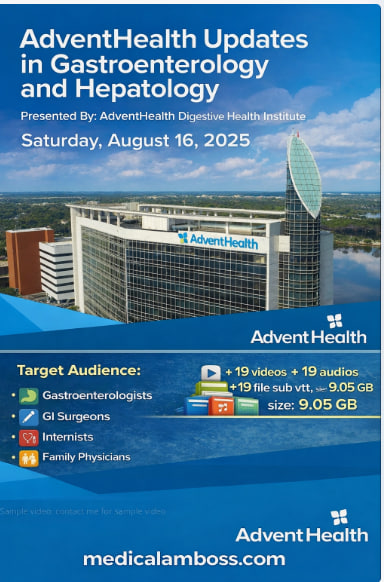
AdventHealth Updates in Gastroenterology and Hepatology 2025
+ Include: 19 videos + 19 audios + 19 file sub vtt, size: 9.05 GB
+ Target Audience: gastroenterologists, GI surgeons, internists, family physicians
+ Information:
- We continue to witness remarkable advancements in the diagnosis and management of gastrointestinal (GI) and liver diseases, with emerging therapies and novel endoscopic techniques transforming clinical practice. However, staying current with these rapid developments presents a challenge for busy healthcare professionals.
- This one-day, in-person conference is designed to deliver concise, high-yield updates on the latest diagnostic, therapeutic, and research advancements in gastroenterology and hepatology. Tailored for gastroenterologists, GI surgeons, internists, family physicians, nurse practitioners, physician assistants, and other healthcare providers with an interest in digestive diseases, this course provides practical, evidence-based strategies for managing a broad spectrum of conditions, including esophageal disease, motility disorders, inflammatory bowel disease, pancreaticobiliary disease, cancer screening, liver disorders, and abdominal pain.
- The program features dynamic educational formats, including lectures, expert panel discussions, and Q&A sessions covering the latest technological innovations, clinical guidelines, and evolving treatment strategies. Additionally, participants will have valuable opportunities to engage with AdventHealth faculty, interact with leading experts, and foster professional connections throughout the course.
Learning Objectives
At the end of this course, learners will be able to:
- Recognize and apply updated clinical guidelines in GI and liver disease management.
- Identify advances in diagnostic tools and therapeutic strategies.
- Integrate new endoscopic technologies into practice.
- Discuss treatment strategies for inflammatory bowel disease and liver disorders.
- Understand cancer screening and management in GI and hepatology.
- Improve multidisciplinary approaches for patient care.
- Recognize and apply updated guidelines in the diagnosis and management of gastrointestinal and liver diseases.
- Identify advances in diagnostic tools and therapeutic strategies for various GI and hepatic conditions.
- Integrate newly available endoscopic technologies into clinical practice.
- Discuss current treatment strategies and emerging therapies for inflammatory bowel disease and chronic liver disorders.
- Review updated recommendations for screening, surveillance, and management of gastrointestinal malignancies.
- Improve collaboration across multidisciplinary teams for optimal patient-centered care.
Target Audience
This program is directed to gastroenterologists, GI surgeons, internists, family physicians, nurse practitioners, physician assistants, and other healthcare providers with an interest in digestive diseases.
+ Topics:
- 01 Updates in Management of EoE
- 02 PCABs in GERD – A New Era of Acid Suppression
- 03 Patients are Implementing Complementary Therapies and Cannabis – Are You Ready
- 04 In the Era of GLP-1 – Impact on GI Care and Endoscopic Practice
- 05 Esophageal Disorders Q&A
- 06 Inpatient Management of IBD
- 07 Mild Crohn’s Disease – Current Guidelines
- 08 Updates in Ulcerative Colitis Guidelines
- 09 Emerging Quality Indicators for Colonoscopy
- 10 IBD & Colon Q&A
- 11 Liver Biopsy and Portal Pressure Measurement – When, Why, How
- 12 Toolbox for Assessment and Management of Patients with Suspected MASH
- 13 Non-Surgical Management of Obesity – Exercise, Pills and Endoscopy
- 14 Steatotic Liver Disease Q&A
- 15 AI – Colon Polyps and Beyond!
- 16 Colon Polyps Resection – Selecting the Right Endoscopic Strategy
- 17 Strategies for Management of Endoscopic Complications
- 18 Interventional EUS – Knows No Boundaries!
- 19 Endoscopy Q&A